Capillary action: what it means and why it matters
Capillary action is the movement of a liquid into a narrow opening without outside force. Adhesion between the liquid and the walls pulls it in, and cohesion within the liquid keeps it together. It is the principle that draws penetrant into a surface-opening crack and later draws it back out into the developer.
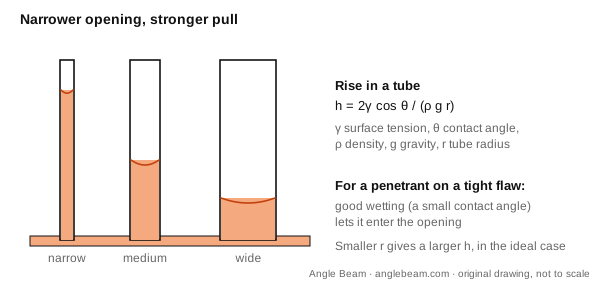
The physics in short
When a liquid touches a solid it either spreads out on the surface or pulls into a bead. The contact angle describes which. A liquid that wets the surface has a small contact angle and spreads, and the same pull that spreads it also draws it into any narrow gap. In a narrow tube the liquid climbs until the weight of the raised column balances the pull. For an ideal tube, the rise is h = 2γ cos θ / (ρ g r), where γ is the surface tension, θ the contact angle, ρ the density, g gravity and r the radius of the tube. The rise is larger when r is smaller and when the liquid wets the wall well.
Try one question
Question 1 of the free 10-question check on PT L2. No signup.
Inspection and Evaluation of Indications
A small, star-shaped indication appears at the end of a weld bead. Which discontinuity is most likely?
Choose an answer to begin
What this means for penetrant
- Wetting. A penetrant is formulated to have a low contact angle on typical metals so it spreads over the surface and enters openings readily.
- Tight flaws. The narrower the opening, the stronger the pull in the ideal model. The flow into a very tight crack is also slow, which is part of why dwell time is allowed.
- Back out again. The developer is a fine powder with many tiny gaps between particles. Those gaps draw penetrant out of the flaw in the same way, which is why the indication forms.
Ask Echo before you buy AI your Angle Beam study buddy
See what's on the PT L2 exam, test yourself with 5 quick questions, or find the plan that fits you.
The PT L2 course
Available now · instant accessLearn every General exam topic, from capillary action to process control, then prove it on timed exams.
- 5modules of lessonsEvery task on the outline
- 3full-length timed exams50 questions in 120 minutes each
- 279practice questionsEach one explained
- 3worked calculationsStep by step
- 1week-by-week study planSet to your exam date
Turn a practice answer into a study step. In untimed practice, ask Echo AI about any question you answer, follow up, then see your weakest topics and what to drill next.
Instant access. Terms and refunds · Secure checkout by Stripe
- NDT MT + PT Level II General bundle$199$59 less than buying both courses separatelyIncludes the MT L2 and PT L2 courses
Terms and refunds · Secure checkout by Stripe
- All three courses bundle$299$108 less than buying the 3 courses separatelyIncludes the UT L2, MT L2 and PT L2 courses
Terms and refunds · Secure checkout by Stripe
- Question of the dayFree
Every answer comes with a full explanation.
Why surface condition matters
Capillary action needs an open path. Anything that blocks the opening stops penetrant from entering, whatever the dwell time. Oil, grease, paint, rust, scale and water inside the flaw all reduce the effect. Machining, grinding, shot or sandblasting and similar work can smear metal across the opening of a fine crack and close it, which is why cleaning and the preparation steps in the procedure come first. A flaw that is not open to the surface cannot fill at all, so PT only shows surface-breaking discontinuities.
Mix-ups to avoid
- Capillary action is not gravity or pressure. It works in any direction, including upward against gravity.
- Surface tension alone does not decide it. The contact angle matters as much, which is why wetting is a requirement for penetrants.
- Not the same as dwell. Dwell is the time allowed. Capillary action is the force acting during that time.
- Penetrant color does not matter here. Visible and fluorescent penetrants both enter by capillary action. See visible vs fluorescent penetrant for how they differ afterward.
How the exam uses it
The PT principles topic opens with this idea. Questions ask what draws penetrant into a flaw, what property a penetrant must have to do it, how a narrow versus wide opening changes it, and which conditions stop it. An answer that names wetting and a clean, open surface is usually the one the question is after.
Topic names here follow ASNT's current PT General outline, which the PT Level II exam guide walks through.
Practice it
Check the principles in the penetrant testing quiz, and see how process conditions are reviewed in the PT process control and indications guide. The time allowed for it to work is in dwell time, and the choice of dye is in visible vs fluorescent penetrant. All terms are in the NDT terms glossary.
Know the term? Check the rest of the PT General topics
Take the free 10-question check. It covers the PT General exam, needs no signup and explains every answer, so you see which topic to study next. The course then adds timed practice exams and a study plan built from your exam date.
Sources
Show the list
Background reading: ASNT's Level II PT self-study collection and published topic headings. Outline checked 25 October 2026.
- Level II PT self-study collection, ASNT.
- ASNT NDT Level II examinations, published topic headings.
Not affiliated with or endorsed by ASNT.
Facts checked 25 October 2026 against the sources listed above. If something has changed, tell us and we will correct it within 2 business days.
Your next step
Ready to see where you stand on PT L2?
Free, untimed and scored by domain. No signup.
Start the free 10-question checkNDT PT Level II General course. Lessons, timed practice exams and a plan around your exam date. Get NDT PT Level II General course · $129 See the plans.Terms and refunds