Leakage field: what it means and why it matters
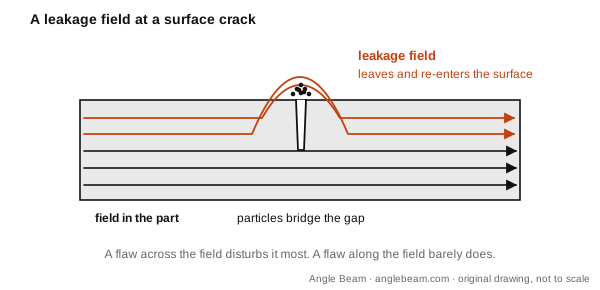
A leakage field is the magnetic flux that escapes from a magnetized part where a flaw interrupts the field. The flux cannot cross the gap easily, so some of it leaves the surface and re-enters on the other side. Magnetic particles collect where it leaves, which is what makes an MT indication.
How it forms
In a magnetized ferromagnetic part the field runs through the metal, because metal is far easier for flux to travel through than air is. A crack or a seam breaks that path. The gap is mostly air, so the flux is forced to detour. Some of it goes around the bottom of the flaw, and some leaves the surface, crosses over the gap in the air and re-enters on the other side. The escaped flux is the leakage field. The two edges of the gap act like small magnetic poles, and fine particles are pulled onto them.
Try one question
Question 1 of the free 10-question check on MT L2. No signup.
Equipment
Ultraviolet (UV-A) lamps used for fluorescent magnetic particle inspection emit mainly near which wavelength?
Choose an answer to begin
What makes it strong or weak
- Orientation. The strongest leakage comes from a flaw that lies at right angles to the field. A flaw lying along the field produces almost none, which is why direction matters so much in longitudinal vs circular magnetization.
- Depth. A flaw at the surface gives a strong, sharp field. A flaw below the surface gives a weaker, broader one that falls off quickly with depth, so MT is mainly for surface and near-surface flaws.
- Width and height of the gap. A tight, deep crack disturbs the field strongly. A shallow scratch disturbs it very little.
- Field strength. The field has to be strong enough to push flux out of the part, but not so strong that the whole part saturates and particles stick everywhere as background.
Ask Echo before you buy AI your Angle Beam study buddy
See what's on the MT L2 exam, test yourself with 5 quick questions, or find the plan that fits you.
The MT L2 course
Available now · instant accessLearn every General exam topic, work the current calculations step by step, then prove it on timed exams.
- 6modules of lessonsEvery task on the outline
- 5full-length timed exams50 questions in 120 minutes each
- 250practice questionsEach one explained
- 7worked calculationsStep by step
- 1week-by-week study planSet to your exam date
Turn a practice answer into a study step. In untimed practice, ask Echo AI about any question you answer, follow up, then see your weakest topics and what to drill next.
Instant access. Terms and refunds · Secure checkout by Stripe
- NDT MT + PT Level II General bundle$199$59 less than buying both courses separatelyIncludes the MT L2 and PT L2 courses
Terms and refunds · Secure checkout by Stripe
- All three courses bundle$299$108 less than buying the 3 courses separatelyIncludes the UT L2, MT L2 and PT L2 courses
Terms and refunds · Secure checkout by Stripe
Every answer comes with a full explanation.
Not every leakage field is a flaw
Anything that disturbs the field can leak it: a sharp change in section, a keyway, a thread root, the edge of a weld, a boundary between hard and soft zones or a spot where two pieces of different metal join. These give nonrelevant indications, which have a real cause but are not a flaw. A different group, false indications, have nothing to do with the field at all, such as lint or particles trapped in a rough spot. The inspector has to sort these from relevant indications using the procedure.
Mix-ups to avoid
- Leakage field versus residual field. The residual field is what remains in the part after the current is switched off. The leakage field exists at a flaw while the part is magnetized. The residual field is covered in demagnetization.
- Subsurface does not mean invisible. It means a weaker indication that needs suitable conditions.
- Particles do not find flaws. They show where the field leaks.
How the exam uses it
Principles, flux fields and effects of discontinuities all come back to this idea. Typical questions ask which flaw will give the strongest indication, why a subsurface flaw gives a fuzzy one, or why a given geometry gave a nonrelevant indication.
Topic names here follow the MT General outline for exams before 15 December 2026; the MT outline change guide shows how the later list lines up.
Practice it
Test your picture of flux in the magnetic particle testing quiz, then use the sketch routine in the MT field direction and technique guide. Flaw direction is the next idea in longitudinal vs circular magnetization, and what stays in the part afterward is demagnetization. See every term in the NDT terms glossary.
Know the term? Check the rest of the MT General topics
Take the free 10-question check. It covers the MT General exam, needs no signup and explains every answer, so you see which topic to study next. The course then adds timed practice exams and a study plan built from your exam date.
Sources
Show the list
Background reading: PCC's magnetic particle section notes and ASNT's published topic headings. Outline checked 25 October 2026.
- Magnetic particle testing section notes, Portland Community College.
- ASNT NDT Level II examinations, published topic headings.
Not affiliated with or endorsed by ASNT.
Facts checked 25 October 2026 against the sources listed above. If something has changed, tell us and we will correct it within 2 business days.
Your next step
Ready to see where you stand on MT L2?
Free, untimed and scored by domain. No signup.
Start the free 10-question checkNDT MT Level II General course. Lessons, timed practice exams and a plan around your exam date. Get NDT MT Level II General course · $129 See the plans.Terms and refunds