Shear wave vs longitudinal wave: what it means and why it matters
In a longitudinal wave the particles move back and forth along the direction the wave travels, in a series of compressions and thin regions. In a shear wave the particles move across the direction of travel. Straight beam probes normally use longitudinal waves, and angle beam probes in steel use shear waves.
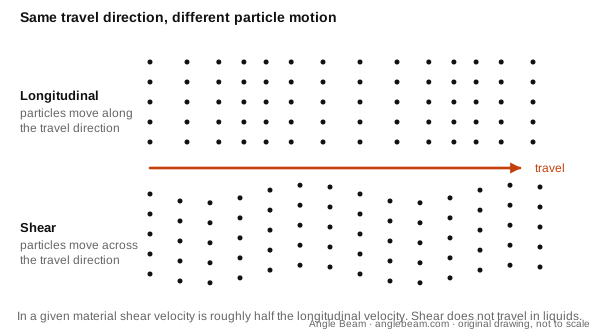
How the particles move
In a longitudinal wave, also called a compression wave, the particles shift along the line of travel. The material is squeezed and stretched in turn. Longitudinal waves can travel in solids, liquids and gases. In a shear wave, also called a transverse wave, the particles shift sideways to the travel direction. A shear wave needs the material to resist being sheared, so it travels in solids but not in liquids or gases.
Try one question
Question 1 of the free 10-question check on UT L2. No signup.
Discontinuity Detection
A planar reflector gives its highest echo amplitude when the beam strikes it
Choose an answer to begin
Velocity and wavelength
In a given solid the shear velocity is roughly half the longitudinal velocity. In steel, values near 5.9 mm/µs for longitudinal and 3.2 mm/µs for shear are typical. Wavelength is velocity divided by frequency, so at 2.25 MHz the longitudinal wavelength is about 2.62 mm and the shear wavelength about 1.42 mm. A shorter wavelength at the same frequency gives better sensitivity to small reflectors, which is one reason shear waves are popular for weld work. It also makes the near field longer, because N grows as wavelength shrinks.
Ask Echo before you buy AI your Angle Beam study buddy
See what's on the UT L2 exam, test yourself with 5 quick questions, or find the plan that fits you.
The UT L2 course
Available now · instant accessLearn every General exam topic, work the calculations step by step, then prove it on timed exams.
- 7modules of lessonsEvery task on the outline
- 5full-length timed exams50 questions in 120 minutes each
- 340practice questionsEach one explained
- 5worked calculationsStep by step
- 1week-by-week study planSet to your exam date
Turn a practice answer into a study step. In untimed practice, ask Echo AI about any question you answer, follow up, then see your weakest topics and what to drill next.
Instant access. Terms and refunds · Secure checkout by Stripe
- All three courses bundle$299$108 less than buying the 3 courses separatelyIncludes the UT L2, MT L2 and PT L2 courses
Terms and refunds · Secure checkout by Stripe
- Free sample lessonFree
- Question of the dayFree
Every answer comes with a full explanation.
Which probe uses which
- Straight beam probe: sends a longitudinal wave straight in. Used for thickness measurement, laminations and general volume checks.
- Angle beam probe in steel: a plastic wedge converts the incident longitudinal wave into a refracted shear wave at a set angle, typically between the critical angles. Used for welds and other flaws that are not square to the surface.
- Surface waves and plate waves: other modes exist and have their own names and uses, but the General exam leans on the first two.
Mode conversion
When a wave meets a boundary at an angle, some of its energy can convert into the other mode. That is why a beam in a part can send a longitudinal echo back from a surface when a shear wave went in, and why odd echoes sometimes appear after the expected ones. Different modes arrive at different times because their velocities differ.
Mix-ups to avoid
- Probe angle versus wave type. An angle beam probe is a shear wave probe in steel. The angle tells you the direction, not the mode.
- Velocity comparison. Longitudinal is faster. Shear is slower and has a shorter wavelength at the same frequency.
- Liquids. Shear waves do not travel in water or oil. On an angle beam probe the couplant film passes a longitudinal wave from the wedge, and the shear wave forms in the steel by refraction.
How the exam uses it
Expect questions on particle motion, on velocity ratios, on which wave a given probe uses, and on wavelength calculations at a given frequency. Keep the units consistent, and note which mode's velocity a question gives you.
Topic names here follow the UT General outline for exams before 5 February 2027; the UT outline change guide shows how the later list lines up.
Practice it
Practice the mode questions in the UT Level 2 quiz, then read the techniques topic in the UT General exam guide. The angle range where shear waves enter is in critical angles, and how the mode changes the numbers in Z is in acoustic impedance. All terms are in the NDT terms glossary.
Know the term? Check the rest of the UT General topics
Take the free 10-question check. It covers the UT General exam, needs no signup and explains every answer, so you see which topic to study next. The course then adds timed practice exams and a study plan built from your exam date.
Sources
Show the list
Background reading: Evident's published UT material and ASNT's published topic headings. Outline checked 25 October 2026.
- Evident, ultrasonic flaw detection tutorial
- Evident, ultrasonic transducer technical notes
- ASNT NDT Level II examinations, published topic headings.
Not affiliated with or endorsed by ASNT.
Facts checked 25 October 2026 against the sources listed above. If something has changed, tell us and we will correct it within 2 business days.
Your next step
Ready to see where you stand on UT L2?
Free, untimed and scored by domain. No signup.
Start the free 10-question checkNDT UT Level II General course. Lessons, timed practice exams and a plan around your exam date. Get NDT UT Level II General course · $149 See the plans or read the free sample lesson.Terms and refunds