Skip distance: what it means and why it matters
Skip distance is how far along the surface an angle beam travels while it crosses a plate to the opposite surface and returns. The trip down to the far surface is a half skip, and the round trip back to the first surface is a full skip. Both depend on plate thickness and the beam angle.
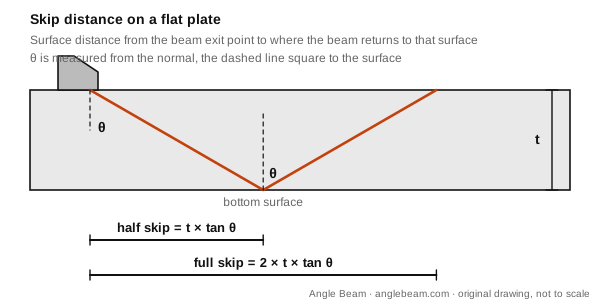
The formula
Draw the beam as a straight line crossing the plate. For a plate of thickness t and a beam angle θ measured from the normal, the horizontal distance covered going down is t × tan θ. That is the half skip. Going down and back up doubles it, so the full skip is 2 × t × tan θ.
Take a 25 mm plate and a 60 degree shear wave. Half skip is 25 × 1.732 = 43.3 mm, and full skip is 86.6 mm. The sound path on each leg is longer than the plate is thick: 25 / cos 60° = 50 mm, so the beam path to the bottom surface is 50 mm even though the depth is only 25 mm. Keep the three lengths apart: depth, surface distance and beam path.
Try one question
Question 1 of the free 10-question check on UT L2. No signup.
Discontinuity Detection
A planar reflector gives its highest echo amplitude when the beam strikes it
Choose an answer to begin
What it is used for
In weld inspection the probe sits beside the weld and the beam is aimed across it. Knowing the half and full skip tells you where to place the probe so the beam reaches the root on the first leg and the cap region on the second leg. It also tells you how far back from the weld the probe has to travel to cover the volume with each leg. A reflector seen on the first leg is located from the index point with t × tan θ style geometry, and one seen on the second leg needs the reflected leg added in.
Ask Echo before you buy AI your Angle Beam study buddy
See what's on the UT L2 exam, test yourself with 5 quick questions, or find the plan that fits you.
The UT L2 course
Available now · instant accessLearn every General exam topic, work the calculations step by step, then prove it on timed exams.
- 7modules of lessonsEvery task on the outline
- 5full-length timed exams50 questions in 120 minutes each
- 340practice questionsEach one explained
- 5worked calculationsStep by step
- 1week-by-week study planSet to your exam date
Turn a practice answer into a study step. In untimed practice, ask Echo AI about any question you answer, follow up, then see your weakest topics and what to drill next.
Instant access. Terms and refunds · Secure checkout by Stripe
- All three courses bundle$299$108 less than buying the 3 courses separatelyIncludes the UT L2, MT L2 and PT L2 courses
Terms and refunds · Secure checkout by Stripe
- Free sample lessonFree
- Question of the dayFree
Every answer comes with a full explanation.
Where the numbers go wrong
- Angle from the surface instead of the normal. The formula above assumes the normal. If a source gives the angle from the surface, the surface distance for one leg is t / tan(angle). Check which convention the question uses before you start.
- Measuring from the wrong point. Skip distance is measured from the beam exit point on the wedge, called the index point, and not from the front edge of the probe.
- Mixing up legs. A 1.5 skip distance lands on the opposite surface again, so it is a full skip plus a half skip. Count the surface contacts, not the number of lines drawn.
- Using thickness for a curved part. The flat plate formula changes for pipe and other curved surfaces, so a question about a curved part will say how to treat it.
How the exam uses it
Skip distance sits under weldment evaluation and general evaluation, the topics that deal with beam geometry. Questions give a thickness and an angle and ask for a half skip, a full skip, a depth or a surface distance. The arithmetic is short once the sketch is right, so draw the plate and mark each leg before touching the calculator.
Topic names here follow the UT General outline for exams before 5 February 2027; the UT outline change guide shows how the later list lines up.
Practice it
Check your own numbers in the skip distance calculator, then work the geometry in the UT formulas guide. The angle that makes the geometry possible comes from critical angles, and the wave that travels it is a shear wave, covered in shear vs longitudinal waves. All twenty terms are in the NDT terms glossary.
Know the term? Check the rest of the UT General topics
Take the free 10-question check. It covers the UT General exam, needs no signup and explains every answer, so you see which topic to study next. The course then adds timed practice exams and a study plan built from your exam date.
Sources
Show the list
Background reading: Evident's published UT material and ASNT's published topic headings. Outline checked 25 October 2026.
- Evident, ultrasonic flaw detection tutorial
- Evident, ultrasonic transducer technical notes
- ASNT NDT Level II examinations, published topic headings.
Not affiliated with or endorsed by ASNT.
Facts checked 25 October 2026 against the sources listed above. If something has changed, tell us and we will correct it within 2 business days.
Your next step
Ready to see where you stand on UT L2?
Free, untimed and scored by domain. No signup.
Start the free 10-question checkNDT UT Level II General course. Lessons, timed practice exams and a plan around your exam date. Get NDT UT Level II General course · $149 See the plans or read the free sample lesson.Terms and refunds