Dead zone: what it means and why it matters
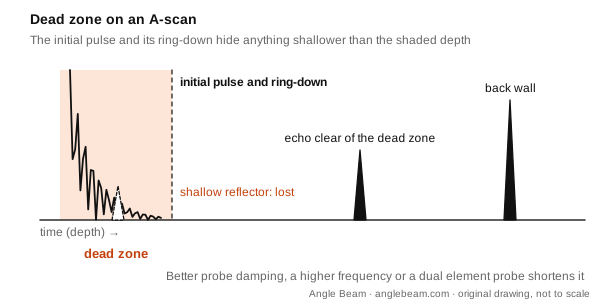
The dead zone is the region just below the scanning surface where echoes cannot be told apart from the initial pulse and its ring-down. A reflector inside it is effectively invisible. The size depends on probe damping, frequency, pulse length and instrument settings, and not on the material alone.
Where it comes from
When the instrument fires, the transducer does not stop moving at once. It rings for a short time after the pulse, and the receiver needs time to recover from the large signal. The screen therefore shows a tall initial pulse followed by a decaying tail. Any echo that arrives while that tail is still large is buried in it. Because echoes from shallow reflectors arrive soonest, the lost region is the depth range closest to the surface.
Try one question
Question 1 of the free 10-question check on UT L2. No signup.
Discontinuity Detection
A planar reflector gives its highest echo amplitude when the beam strikes it
Choose an answer to begin
What changes its size
- Damping: a well-damped transducer stops ringing sooner, which shortens the dead zone.
- Frequency: a higher frequency means shorter pulses, which tends to make the dead zone shorter.
- Gain: a high gain makes the tail look taller and stretches the dead zone.
- Probe type: dual element probes use separate transmit and receive crystals, so the receiver is less affected by the pulse and the region close to the surface can be read.
- Delay line or wedge: a delay moves the initial pulse away from the surface of the part, so the dead zone falls inside the delay and not inside the test material. An angle beam wedge does the same thing for the part's surface.
Ask Echo before you buy AI your Angle Beam study buddy
See what's on the UT L2 exam, test yourself with 5 quick questions, or find the plan that fits you.
The UT L2 course
Available now · instant accessLearn every General exam topic, work the calculations step by step, then prove it on timed exams.
- 7modules of lessonsEvery task on the outline
- 5full-length timed exams50 questions in 120 minutes each
- 340practice questionsEach one explained
- 5worked calculationsStep by step
- 1week-by-week study planSet to your exam date
Turn a practice answer into a study step. In untimed practice, ask Echo AI about any question you answer, follow up, then see your weakest topics and what to drill next.
Instant access. Terms and refunds · Secure checkout by Stripe
- All three courses bundle$299$108 less than buying the 3 courses separatelyIncludes the UT L2, MT L2 and PT L2 courses
Terms and refunds · Secure checkout by Stripe
- Free sample lessonFree
- Question of the dayFree
Every answer comes with a full explanation.
Near field and dead zone are different
The near field is about the beam: the pressure on the axis rises and falls near the element, and it would exist even with perfect electronics. The dead zone is about the electronics and the transducer ringing. They sit in the same region, so it is easy to confuse them. Fixing one does not fix the other. The first limits how reliably echo height shows size, and the second limits whether you can see an echo at all. See near field.
Practical effects
- Thin material: if the plate is thinner than the dead zone, a straight beam probe cannot resolve the back wall separately from the initial pulse.
- Near-surface flaws: a flaw close to the scan surface may need a dual element probe, a different frequency or a scan from the opposite side.
- Beam shape does not help. A narrow beam spread does not shorten the dead zone.
How the exam uses it
Questions ask what causes a dead zone, which probe type reduces it, and what happens to a shallow reflector inside it. Give the ring-down as the cause, not the near field, and remember that the remedy changes the probe or setup, not the part.
Topic names here follow the UT General outline for exams before 5 February 2027; the UT outline change guide shows how the later list lines up.
Practice it
Work the surface-resolution questions in the UT Level 2 quiz, then read the evaluation topics in the UT General exam guide. The beam-physics region that shares the same depth is the near field, and the far-field widening is beam spread. All terms are in the NDT terms glossary.
Know the term? Check the rest of the UT General topics
Take the free 10-question check. It covers the UT General exam, needs no signup and explains every answer, so you see which topic to study next. The course then adds timed practice exams and a study plan built from your exam date.
Sources
Show the list
Background reading: Evident's published UT material and ASNT's published topic headings. Outline checked 25 October 2026.
- Evident, ultrasonic flaw detection tutorial
- Evident, ultrasonic transducer technical notes
- ASNT NDT Level II examinations, published topic headings.
Not affiliated with or endorsed by ASNT.
Facts checked 25 October 2026 against the sources listed above. If something has changed, tell us and we will correct it within 2 business days.
Your next step
Ready to see where you stand on UT L2?
Free, untimed and scored by domain. No signup.
Start the free 10-question checkNDT UT Level II General course. Lessons, timed practice exams and a plan around your exam date. Get NDT UT Level II General course · $149 See the plans or read the free sample lesson.Terms and refunds