Wet vs dry magnetic particles: what it means and why it matters
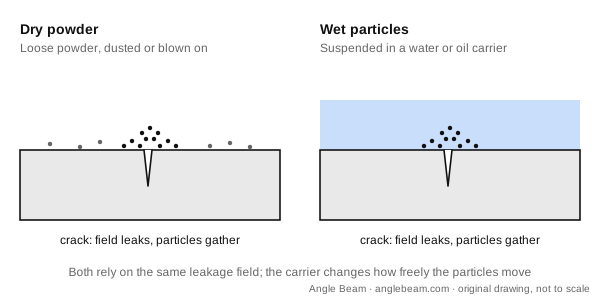
Dry magnetic particles are a loose powder dusted or blown onto the magnetized part. Wet magnetic particles are suspended in a liquid carrier, oil or water, which is sprayed or flowed over the part. Both gather at the leakage field of a flaw. The carrier changes how the particles move and how fine an indication they show.
What differs
Dry particles are applied as a loose powder, usually with a bulb or a powder applicator, in a light cloud so they settle on the surface. The excess is removed gently with a light air stream. They are portable, need no bath, and work on rough surfaces such as castings and weld caps where a liquid carrier would run off or pool. With the right current type the field penetrates deeper, and dry powder can show some flaws that lie just below the surface.
Wet particles are mixed into a carrier, either oil or conditioned water, and applied by spray, hose or a bath. The liquid lets very fine particles move freely to the leakage field, which makes wet particles the usual choice for fine surface cracks on smooth parts. Stationary equipment can wash and recirculate the bath on production parts.
Try one question
Question 1 of the free 10-question check on MT L2. No signup.
Equipment
Ultraviolet (UV-A) lamps used for fluorescent magnetic particle inspection emit mainly near which wavelength?
Choose an answer to begin
Looking after a wet bath
A wet bath changes as it is used. Particles settle, concentration drifts, and dirt, oil or lint build up. The procedure sets how often to check it, and the check is usually a settling test in a graduated tube that gives the volume of particles in a set amount of bath. Too few particles weaken the indications, and too many raise the background. A water bath also needs conditioning agents so that it wets the surface and does not foam or rust. The numerical limits come from the procedure.
Ask Echo before you buy AI your Angle Beam study buddy
See what's on the MT L2 exam, test yourself with 5 quick questions, or find the plan that fits you.
The MT L2 course
Available now · instant accessLearn every General exam topic, work the current calculations step by step, then prove it on timed exams.
- 6modules of lessonsEvery task on the outline
- 5full-length timed exams50 questions in 120 minutes each
- 250practice questionsEach one explained
- 7worked calculationsStep by step
- 1week-by-week study planSet to your exam date
Turn a practice answer into a study step. In untimed practice, ask Echo AI about any question you answer, follow up, then see your weakest topics and what to drill next.
Instant access. Terms and refunds · Secure checkout by Stripe
- NDT MT + PT Level II General bundle$199$59 less than buying both courses separatelyIncludes the MT L2 and PT L2 courses
Terms and refunds · Secure checkout by Stripe
- All three courses bundle$299$108 less than buying the 3 courses separatelyIncludes the UT L2, MT L2 and PT L2 courses
Terms and refunds · Secure checkout by Stripe
Every answer comes with a full explanation.
Two separate choices
People merge two ideas that are independent:
- Wet or dry describes the carrier.
- Visible or fluorescent describes the particle color. Visible particles come in colors chosen for contrast with the part, and fluorescent particles glow under ultraviolet light in a darkened area.
Either carrier can be paired with either color, subject to the procedure. A question that asks about wet particles has not told you whether they are fluorescent.
Mix-ups to avoid
- Wet versus continuous. Continuous means the particles are applied while the magnetizing current is on. Wet or dry is a different axis.
- Dry is not less sensitive in every case. It is better on rough or hard-to-wet surfaces, and wet is better for fine surface cracks on smooth parts.
- Water baths are not oil baths. Fire safety and conditioning needs differ, so do not carry the checks across.
How the exam uses it
Questions in the equipment and quality control topics ask which carrier suits a surface or a flaw type, how bath concentration is checked and why, and what limits each approach. Read the surface and the flaw before reading the answers.
Topic names here follow the MT General outline for exams before 15 December 2026; the MT outline change guide shows how the later list lines up.
Practice it
Try the equipment and particle questions in the magnetic particle testing quiz, then use the technique checklist in the MT field direction and technique guide. The reason the particles collect at all is the leakage field, and the field choice that decides what shows is in longitudinal vs circular magnetization. The full list is in the NDT terms glossary.
Know the term? Check the rest of the MT General topics
Take the free 10-question check. It covers the MT General exam, needs no signup and explains every answer, so you see which topic to study next. The course then adds timed practice exams and a study plan built from your exam date.
Sources
Show the list
Background reading: PCC's magnetic particle section notes and ASNT's published topic headings. Outline checked 25 October 2026.
- Magnetic particle testing section notes, Portland Community College.
- ASNT NDT Level II examinations, published topic headings.
Not affiliated with or endorsed by ASNT.
Facts checked 25 October 2026 against the sources listed above. If something has changed, tell us and we will correct it within 2 business days.
Your next step
Ready to see where you stand on MT L2?
Free, untimed and scored by domain. No signup.
Start the free 10-question checkNDT MT Level II General course. Lessons, timed practice exams and a plan around your exam date. Get NDT MT Level II General course · $129 See the plans.Terms and refunds