Demagnetization: what it means and why it matters
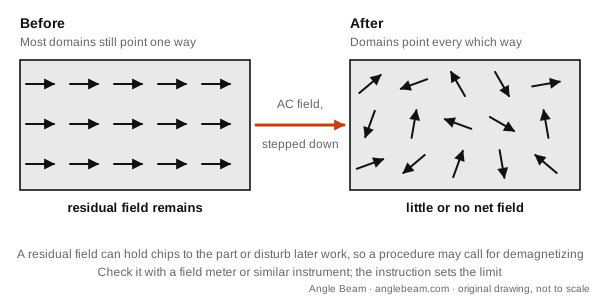
Demagnetization is the removal of the magnetic field a part keeps after magnetic particle testing. It is done by exposing the part to an alternating field that is stepped down gradually to near zero, which scrambles the magnetic domains. The result is checked with a field meter or similar instrument, not by eye.
Why it is done
A magnetized part keeps a residual field. That field can attract iron chips and fine swarf during machining, damage bearing surfaces and gears, interfere with arc welding by deflecting the arc, upset sensitive instruments, and make later inspections or cleaning harder. Whether a part must be demagnetized is set by the procedure or specification. Parts that will be heated, remachined or welded afterward are common cases, while some parts need nothing.
Try one question
Question 1 of the free 10-question check on MT L2. No signup.
Equipment
Ultraviolet (UV-A) lamps used for fluorescent magnetic particle inspection emit mainly near which wavelength?
Choose an answer to begin
How it is done
The principle is the same in each method: apply a field that reverses direction while it decreases.
- AC coil. The part is passed slowly through a coil carrying alternating current and then drawn well away from the coil before the current is shut off. Shutting it off while the part is inside can leave a field.
- AC with decreasing current. The part stays in the coil or between contacts while the current is reduced smoothly to zero.
- DC reversing and stepped down. The current is reversed and reduced in steps. Direct current penetrates further than alternating current, so it suits larger or heavier sections where AC acts mostly near the surface.
- Heating above the Curie temperature. The part loses its magnetism completely. This is rarely practical.
Ask Echo before you buy AI your Angle Beam study buddy
See what's on the MT L2 exam, test yourself with 5 quick questions, or find the plan that fits you.
The MT L2 course
Available now · instant accessLearn every General exam topic, work the current calculations step by step, then prove it on timed exams.
- 6modules of lessonsEvery task on the outline
- 5full-length timed exams50 questions in 120 minutes each
- 250practice questionsEach one explained
- 7worked calculationsStep by step
- 1week-by-week study planSet to your exam date
Turn a practice answer into a study step. In untimed practice, ask Echo AI about any question you answer, follow up, then see your weakest topics and what to drill next.
Instant access. Terms and refunds · Secure checkout by Stripe
- NDT MT + PT Level II General bundle$199$59 less than buying both courses separatelyIncludes the MT L2 and PT L2 courses
Terms and refunds · Secure checkout by Stripe
- All three courses bundle$299$108 less than buying the 3 courses separatelyIncludes the UT L2, MT L2 and PT L2 courses
Terms and refunds · Secure checkout by Stripe
Every answer comes with a full explanation.
The circular field problem
A part magnetized circularly has its field closed in rings inside the metal, so very little escapes to the outside. A field meter held against it may read almost nothing even though a strong residual field is present. A longitudinal shot replaces the ring field with one that has poles at the ends, and a field indicator can read the leakage from those poles. So the usual advice is to convert a circularly magnetized part with a longitudinal field first, then demagnetize it, and to check the residual field before and after that step.
Checking the result
A field indicator or magnetometer measures what is left. The acceptable level is set by the specification. Do not rely on whether particles stick or whether a compass moves as the only test.
Mix-ups to avoid
- Demagnetizing is not the same as cleaning. Washing the part does not change its field.
- Distance from the coil counts. The part should be well clear before the current is switched off.
- Orientation helps. Long parts are usually placed with their long axis along the coil axis.
How the exam uses it
Demagnetization procedures is its own topic in the MT General outline for exams before 15 December 2026. Questions ask why it is needed, which method suits which part, what the circular-field complication is, and how it is verified. The leakage idea behind the residual field is in the leakage field page.
Topic names here follow the MT General outline for exams before 15 December 2026; the MT outline change guide shows how the later list lines up.
Practice it
Work the demagnetization questions in the magnetic particle testing quiz, then see the technique workflow in the MT field direction and technique guide. The field that remains behind starts as a leakage field, and the circular-field point links to longitudinal vs circular magnetization. Browse the NDT terms glossary.
Know the term? Check the rest of the MT General topics
Take the free 10-question check. It covers the MT General exam, needs no signup and explains every answer, so you see which topic to study next. The course then adds timed practice exams and a study plan built from your exam date.
Sources
Show the list
Background reading: PCC's magnetic particle section notes and ASNT's published topic headings. Outline checked 25 October 2026.
- Magnetic particle testing section notes, Portland Community College.
- ASNT NDT Level II examinations, published topic headings.
Not affiliated with or endorsed by ASNT.
Facts checked 25 October 2026 against the sources listed above. If something has changed, tell us and we will correct it within 2 business days.
Your next step
Ready to see where you stand on MT L2?
Free, untimed and scored by domain. No signup.
Start the free 10-question checkNDT MT Level II General course. Lessons, timed practice exams and a plan around your exam date. Get NDT MT Level II General course · $129 See the plans.Terms and refunds