Dwell time: what it means and why it matters
Dwell time is the period the penetrant stays on the part, from the moment it is applied until removal of the excess begins. It gives the liquid time to be drawn into surface-opening flaws. The required length depends on the materials, the part and the flaw, and it is set by the written procedure.
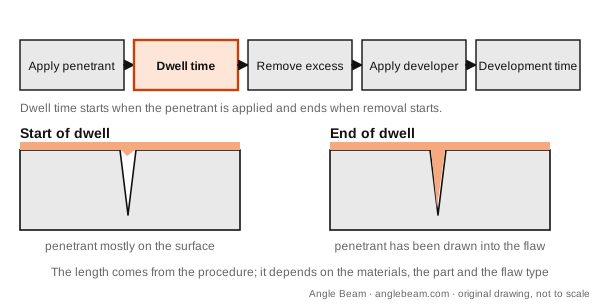
What happens during dwell
Penetrant is a thin liquid chosen to wet the surface well. Once on the part it is drawn into any opening by capillary action. A wide, open crack fills quickly. A tight or narrow crack takes longer. The dwell is the time allowed for that to happen. The part is kept wet with penetrant during this time, applied again if it begins to dry.
Try one question
Question 1 of the free 10-question check on PT L2. No signup.
Inspection and Evaluation of Indications
A small, star-shaped indication appears at the end of a weld bead. Which discontinuity is most likely?
Choose an answer to begin
Too short or too long
- Too short: the penetrant has not filled tight flaws, so they are missed or show only faintly.
- Too long: the penetrant can dry or become thick on the surface, which makes it hard to remove and raises the background. On a warm surface it may dry within the dwell. A heavy background hides small indications.
Dwell is not a single standard figure. It changes with the type of penetrant, the material, the flaw type, the temperature of the part and the method of application. Tables in the standard or the procedure give a time for each combination, and your procedure governs.
Ask Echo before you buy AI your Angle Beam study buddy
See what's on the PT L2 exam, test yourself with 5 quick questions, or find the plan that fits you.
The PT L2 course
Available now · instant accessLearn every General exam topic, from capillary action to process control, then prove it on timed exams.
- 5modules of lessonsEvery task on the outline
- 3full-length timed exams50 questions in 120 minutes each
- 279practice questionsEach one explained
- 3worked calculationsStep by step
- 1week-by-week study planSet to your exam date
Turn a practice answer into a study step. In untimed practice, ask Echo AI about any question you answer, follow up, then see your weakest topics and what to drill next.
Instant access. Terms and refunds · Secure checkout by Stripe
- NDT MT + PT Level II General bundle$199$59 less than buying both courses separatelyIncludes the MT L2 and PT L2 courses
Terms and refunds · Secure checkout by Stripe
- All three courses bundle$299$108 less than buying the 3 courses separatelyIncludes the UT L2, MT L2 and PT L2 courses
Terms and refunds · Secure checkout by Stripe
- Question of the dayFree
Every answer comes with a full explanation.
Two timers that get mixed up
- Penetrant dwell time: application to removal. It is the one this page covers.
- Development time: the period after the developer is applied during which penetrant is drawn out of the flaw into the developer and indications form. Inspection is carried out during or after the development time in the window the procedure names. See developer types.
- Emulsification time: the time an emulsifier is allowed to work on a post-emulsifiable penetrant. It is short and tightly controlled. Do not confuse it with dwell.
Temperature and part condition
Colder parts slow the process and may need longer dwell or a different procedure, and very hot parts can dry the penetrant too fast. The procedure gives the temperature range in which the process is valid. A dirty or contaminated surface blocks entry whatever the dwell, so cleaning comes first. The reason liquids move into narrow gaps is explained in capillary action.
How the exam uses it
PT principles and procedures come back to this. Typical questions ask what dwell time is, what happens when it is too short, which factors lengthen it, and how it differs from development time. The procedure supplies the numbers, so questions test understanding of the idea and the sequence, not memory of minutes.
Topic names here follow ASNT's current PT General outline, which the PT Level II exam guide walks through.
Practice it
Check the sequence and the timing terms in the penetrant testing quiz, then see how process steps are reviewed in the PT process control and indications guide. The step after dwell and removal is covered in developer types, and the force behind dwell is capillary action. All terms are in the NDT terms glossary.
Know the term? Check the rest of the PT General topics
Take the free 10-question check. It covers the PT General exam, needs no signup and explains every answer, so you see which topic to study next. The course then adds timed practice exams and a study plan built from your exam date.
Sources
Show the list
Background reading: ASNT's Level II PT self-study collection and published topic headings. Outline checked 25 October 2026.
- Level II PT self-study collection, ASNT.
- ASNT NDT Level II examinations, published topic headings.
Not affiliated with or endorsed by ASNT.
Facts checked 25 October 2026 against the sources listed above. If something has changed, tell us and we will correct it within 2 business days.
Your next step
Ready to see where you stand on PT L2?
Free, untimed and scored by domain. No signup.
Start the free 10-question checkNDT PT Level II General course. Lessons, timed practice exams and a plan around your exam date. Get NDT PT Level II General course · $129 See the plans.Terms and refunds