Visible vs fluorescent penetrant: what it means and why it matters
Visible penetrant contains a colored dye, usually red, seen against a white developer in normal white light. Fluorescent penetrant contains a dye that glows under ultraviolet-A light in a darkened area. Both enter flaws the same way. They differ in how the indication is seen, and in the lighting and equipment needed.
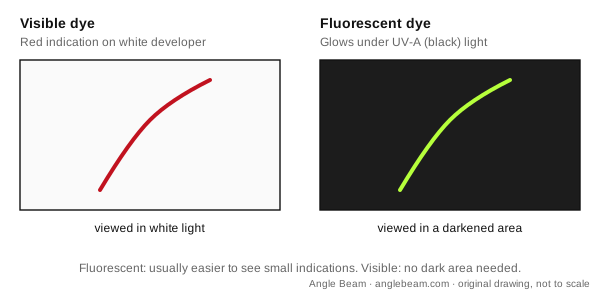
How each is seen
Visible dye shows as a bright, usually red, line or spot on the white background left by the developer. It is viewed in white light, so no darkened area is needed. That makes it a good fit for field work, outdoors and for large or fixed parts where a booth is impractical. Enough light must be present, and the procedure specifies the minimum at the surface.
Fluorescent dye glows yellow-green when it absorbs ultraviolet-A light, also called black light. It is viewed in a darkened area where white light is kept low, and the eye needs a minute or so to adapt to the dark. Against a dark background even a small amount of glowing penetrant is easy to see, which is why fluorescent penetrant is generally the more sensitive choice for finding fine indications.
Try one question
Question 1 of the free 10-question check on PT L2. No signup.
Inspection and Evaluation of Indications
A small, star-shaped indication appears at the end of a weld bead. Which discontinuity is most likely?
Choose an answer to begin
What each one needs
- Visible: white developer for contrast, adequate white light, and a clean background.
- Fluorescent: a UV-A lamp that has warmed up and been checked for output with a meter, a darkened viewing area, and limits on stray white light. Ultraviolet exposure to the eyes and skin is kept low.
- Both: a clean surface, proper dwell and removal, and developer applied in a thin even layer.
Ask Echo before you buy AI your Angle Beam study buddy
See what's on the PT L2 exam, test yourself with 5 quick questions, or find the plan that fits you.
The PT L2 course
Available now · instant accessLearn every General exam topic, from capillary action to process control, then prove it on timed exams.
- 5modules of lessonsEvery task on the outline
- 3full-length timed exams50 questions in 120 minutes each
- 279practice questionsEach one explained
- 3worked calculationsStep by step
- 1week-by-week study planSet to your exam date
Turn a practice answer into a study step. In untimed practice, ask Echo AI about any question you answer, follow up, then see your weakest topics and what to drill next.
Instant access. Terms and refunds · Secure checkout by Stripe
- NDT MT + PT Level II General bundle$199$59 less than buying both courses separatelyIncludes the MT L2 and PT L2 courses
Terms and refunds · Secure checkout by Stripe
- All three courses bundle$299$108 less than buying the 3 courses separatelyIncludes the UT L2, MT L2 and PT L2 courses
Terms and refunds · Secure checkout by Stripe
- Question of the dayFree
Every answer comes with a full explanation.
Why parts are not swapped between types
A part that has been inspected with one type is normally not re-inspected with the other. Residue from the first process can hide the dye of the second or reduce its brightness, particularly when the first test used visible dye and the second is fluorescent. If a part must be retested, the procedure sets cleaning requirements, and a different type may be restricted. Follow the procedure rather than assuming a thorough wash is enough.
Mix-ups to avoid
- Dye type versus removal method. Each dye type can come in water-washable, post-emulsifiable and solvent-removable forms. See penetrant removal methods.
- Visible does not mean insensitive. It is a legitimate choice with its own procedures, and often the one used in the field.
- Fluorescent does not mean no light. The white light level is limited, not zero.
- Developer pairing. Dry powder is normally used with fluorescent only. See developer types.
How the exam uses it
Method selection and procedures include this choice. Typical questions give a setting such as a booth, a field repair or fine cracks on machined parts and ask which type fits, or ask about the lighting each needs and the checks on the UV lamp. The same capillary action draws both into the flaw, which is the point of the capillary action page.
Topic names here follow ASNT's current PT General outline, which the PT Level II exam guide walks through.
Practice it
Match setting to dye in the penetrant testing quiz, then see how process conditions are reviewed in the PT process control and indications guide. The developer pairing is in developer types, and the force behind both dyes is capillary action. Browse the NDT terms glossary.
Know the term? Check the rest of the PT General topics
Take the free 10-question check. It covers the PT General exam, needs no signup and explains every answer, so you see which topic to study next. The course then adds timed practice exams and a study plan built from your exam date.
Sources
Show the list
Background reading: ASNT's Level II PT self-study collection and published topic headings. Outline checked 25 October 2026.
- Level II PT self-study collection, ASNT.
- ASNT NDT Level II examinations, published topic headings.
Not affiliated with or endorsed by ASNT.
Facts checked 25 October 2026 against the sources listed above. If something has changed, tell us and we will correct it within 2 business days.
Your next step
Ready to see where you stand on PT L2?
Free, untimed and scored by domain. No signup.
Start the free 10-question checkNDT PT Level II General course. Lessons, timed practice exams and a plan around your exam date. Get NDT PT Level II General course · $129 See the plans.Terms and refunds