Couplant: what it means and why it matters
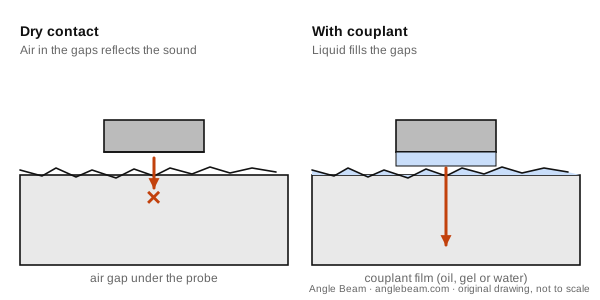
Couplant is a liquid, gel or paste placed between a contact probe and the test surface so that sound can pass into the part. Without it, a thin layer of air remains in the gaps and reflects almost all of the energy. Couplant fills the gaps and lets the sound through with little loss.
Why air is the problem
Sound crosses a boundary well when the two sides have similar acoustic impedance, and badly when they differ a great deal. Steel is about 46 million kg/(m²·s) and air is about 0.0004 million. Put those into the reflection formula and more than 99.99 percent of the intensity reflects at a steel and air boundary. Even a hair-thin air gap under a probe therefore blocks the signal. Couplant has an impedance far closer to the probe and the part, so most of the energy passes. The idea behind the number is covered on the acoustic impedance page.
Try one question
Question 1 of the free 10-question check on UT L2. No signup.
Discontinuity Detection
A planar reflector gives its highest echo amplitude when the beam strikes it
Choose an answer to begin
Choosing a couplant
- Water is the usual choice for immersion work and for smooth surfaces. It runs off vertical or overhead surfaces and can promote corrosion on some metals.
- Oil, gel and grease stay in place on rough, vertical or overhead surfaces and fill larger gaps.
- Special products are used where the part is hot, cold or sensitive. Some materials limit contaminants such as halogens or sulfur in the couplant, so the procedure names what is allowed.
- Wedge and contact condition. On an angle beam probe the couplant has to fill the gap under the whole wedge face, not just under part of it.
Ask Echo before you buy AI your Angle Beam study buddy
See what's on the UT L2 exam, test yourself with 5 quick questions, or find the plan that fits you.
The UT L2 course
Available now · instant accessLearn every General exam topic, work the calculations step by step, then prove it on timed exams.
- 7modules of lessonsEvery task on the outline
- 5full-length timed exams50 questions in 120 minutes each
- 340practice questionsEach one explained
- 5worked calculationsStep by step
- 1week-by-week study planSet to your exam date
Turn a practice answer into a study step. In untimed practice, ask Echo AI about any question you answer, follow up, then see your weakest topics and what to drill next.
Instant access. Terms and refunds · Secure checkout by Stripe
- All three courses bundle$299$108 less than buying the 3 courses separatelyIncludes the UT L2, MT L2 and PT L2 courses
Terms and refunds · Secure checkout by Stripe
- Free sample lessonFree
- Question of the dayFree
Every answer comes with a full explanation.
Keep it the same
Couplant changes the signal. A thicker film, a different product or rougher surface contact can change echo height by several dB. For that reason calibration should be done with the same type of couplant, and on a surface of similar roughness, as the test. If the surface of the part is much rougher than the block, a transfer correction may be required. A sudden drop in signal during a scan is often a couplant problem, so check for it before suspecting the part.
Mix-ups to avoid
- Couplant is not a lubricant. Its job is to pass sound, and a good lubricant can still be a poor couplant.
- Thicker is not better. A thin, complete film is the target. Excess couplant can cause ripples in the signal and sloppiness in the probe position.
- Surface conditions still matter. Couplant fills small gaps. It will not rescue heavy scale, loose paint or a very uneven surface.
How the exam uses it
Couplant questions ask why it is needed, what happens when the layer is incomplete, and why calibration and testing must use the same couplant. The reasoning is always the impedance difference between air and solids, with the consequence of weak or lost signal.
Topic names here follow the UT General outline for exams before 5 February 2027; the UT outline change guide shows how the later list lines up.
Practice it
Test the idea against the UT Level 2 quiz, then read the technique topics in the UT General exam guide. Next, see why air blocks sound in acoustic impedance, and why the surface zone can be unreadable even with good coupling in the dead zone. All terms are in the NDT terms glossary.
Know the term? Check the rest of the UT General topics
Take the free 10-question check. It covers the UT General exam, needs no signup and explains every answer, so you see which topic to study next. The course then adds timed practice exams and a study plan built from your exam date.
Sources
Show the list
Background reading: Evident's published UT material and ASNT's published topic headings. Outline checked 25 October 2026.
- Evident, ultrasonic flaw detection tutorial
- Evident, ultrasonic transducer technical notes
- ASNT NDT Level II examinations, published topic headings.
Not affiliated with or endorsed by ASNT.
Facts checked 25 October 2026 against the sources listed above. If something has changed, tell us and we will correct it within 2 business days.
Your next step
Ready to see where you stand on UT L2?
Free, untimed and scored by domain. No signup.
Start the free 10-question checkNDT UT Level II General course. Lessons, timed practice exams and a plan around your exam date. Get NDT UT Level II General course · $149 See the plans or read the free sample lesson.Terms and refunds