DAC curve: what it means and why it matters
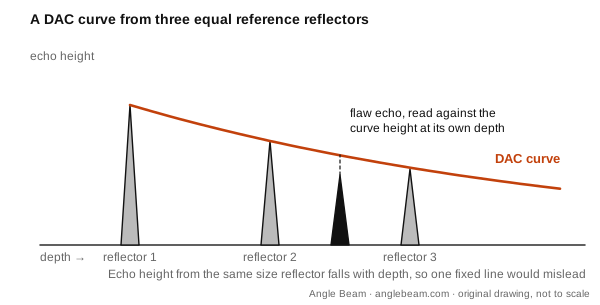
A distance amplitude correction curve, or DAC curve, is a line drawn on the screen through the echo heights from identical reference reflectors at different depths. Because the same reflector gives a lower echo the deeper it is, the curve lets an inspector judge a flaw echo against what a reference reflector would give at that same depth.
How it is built
The setup uses a reference block with identical reflectors, such as side-drilled holes, at several depths. With the probe and instrument settings fixed, the inspector moves the probe to peak the echo from each reflector in turn and marks its height on the screen. Joining the marks gives the curve. Depth runs along the screen and echo height up it, so the curve slopes down, because beam spread and attenuation reduce echo height with distance.
The curve belongs to the exact combination used to build it: probe, wedge, frequency, beam angle, instrument settings and material. Change any of those and the curve is no longer valid.
Try one question
Question 1 of the free 10-question check on UT L2. No signup.
Discontinuity Detection
A planar reflector gives its highest echo amplitude when the beam strikes it
Choose an answer to begin
How a flaw echo is read against it
Once the curve exists, a flaw echo is compared with the curve height at the flaw's depth. Reports typically give the flaw echo as a percentage of the curve or as a number of decibels above or below it. If the curve is at 50 percent of screen height at that depth and the flaw echo is 25 percent, the echo is half the curve height, or 6 dB below it. The acceptance limit in terms of the curve comes from the governing procedure or code, not from this page.
Ask Echo before you buy AI your Angle Beam study buddy
See what's on the UT L2 exam, test yourself with 5 quick questions, or find the plan that fits you.
The UT L2 course
Available now · instant accessLearn every General exam topic, work the calculations step by step, then prove it on timed exams.
- 7modules of lessonsEvery task on the outline
- 5full-length timed exams50 questions in 120 minutes each
- 340practice questionsEach one explained
- 5worked calculationsStep by step
- 1week-by-week study planSet to your exam date
Turn a practice answer into a study step. In untimed practice, ask Echo AI about any question you answer, follow up, then see your weakest topics and what to drill next.
Instant access. Terms and refunds · Secure checkout by Stripe
- All three courses bundle$299$108 less than buying the 3 courses separatelyIncludes the UT L2, MT L2 and PT L2 courses
Terms and refunds · Secure checkout by Stripe
- Free sample lessonFree
- Question of the dayFree
Every answer comes with a full explanation.
DAC compared with similar ideas
- Time corrected gain (TCG). The instrument raises gain with time so the reference echoes line up at one height. The curve becomes a flat line. Both ideas correct for distance loss; TCG does it electronically.
- Reference level. A single reference reflector at a single depth gives one amplitude, not a curve across depths.
- DGS or AVG diagrams. These estimate reflector size from calculated curves for a probe, not from reference reflectors in a block.
Where it goes wrong
- Different material. If the test part has a different attenuation or surface condition than the block, the curve under- or over-states the flaw. A transfer correction may be needed.
- Near field. Echoes from inside the near field are irregular, so the curve often starts beyond it or is built from points past it.
- Changed couplant or gain. Any setting change after the curve is built means rebuilding or verifying it.
How the exam uses it
DAC appears under general evaluation. Expect a sketch of a curve with a flaw echo, and a question asking for its percentage of DAC or its dB difference from the curve, or a question on what makes the curve invalid. Practice the dB conversion until a half or a double is automatic.
Topic names here follow the UT General outline for exams before 5 February 2027; the UT outline change guide shows how the later list lines up.
Practice it
Use the decibel calculator to turn an echo ratio into dB, and read the calibration topics in the UT formulas guide. Two of the reasons the curve falls are covered in attenuation and the near field. All terms are listed in the NDT terms glossary.
Know the term? Check the rest of the UT General topics
Take the free 10-question check. It covers the UT General exam, needs no signup and explains every answer, so you see which topic to study next. The course then adds timed practice exams and a study plan built from your exam date.
Sources
Show the list
Background reading: Evident's published UT material and ASNT's published topic headings. Outline checked 25 October 2026.
- Evident, ultrasonic flaw detection tutorial
- Evident, ultrasonic transducer technical notes
- ASNT NDT Level II examinations, published topic headings.
Not affiliated with or endorsed by ASNT.
Facts checked 25 October 2026 against the sources listed above. If something has changed, tell us and we will correct it within 2 business days.
Your next step
Ready to see where you stand on UT L2?
Free, untimed and scored by domain. No signup.
Start the free 10-question checkNDT UT Level II General course. Lessons, timed practice exams and a plan around your exam date. Get NDT UT Level II General course · $149 See the plans or read the free sample lesson.Terms and refunds